Cable Fault Identification Services
Cable fault location is the process of locating periodic faults, such as insulation faults in cables. In essence, a device called the thumper, or surge wave generator, creates a high voltage surge which is launched out onto the faulted cable.
Cable Fault Identification Services
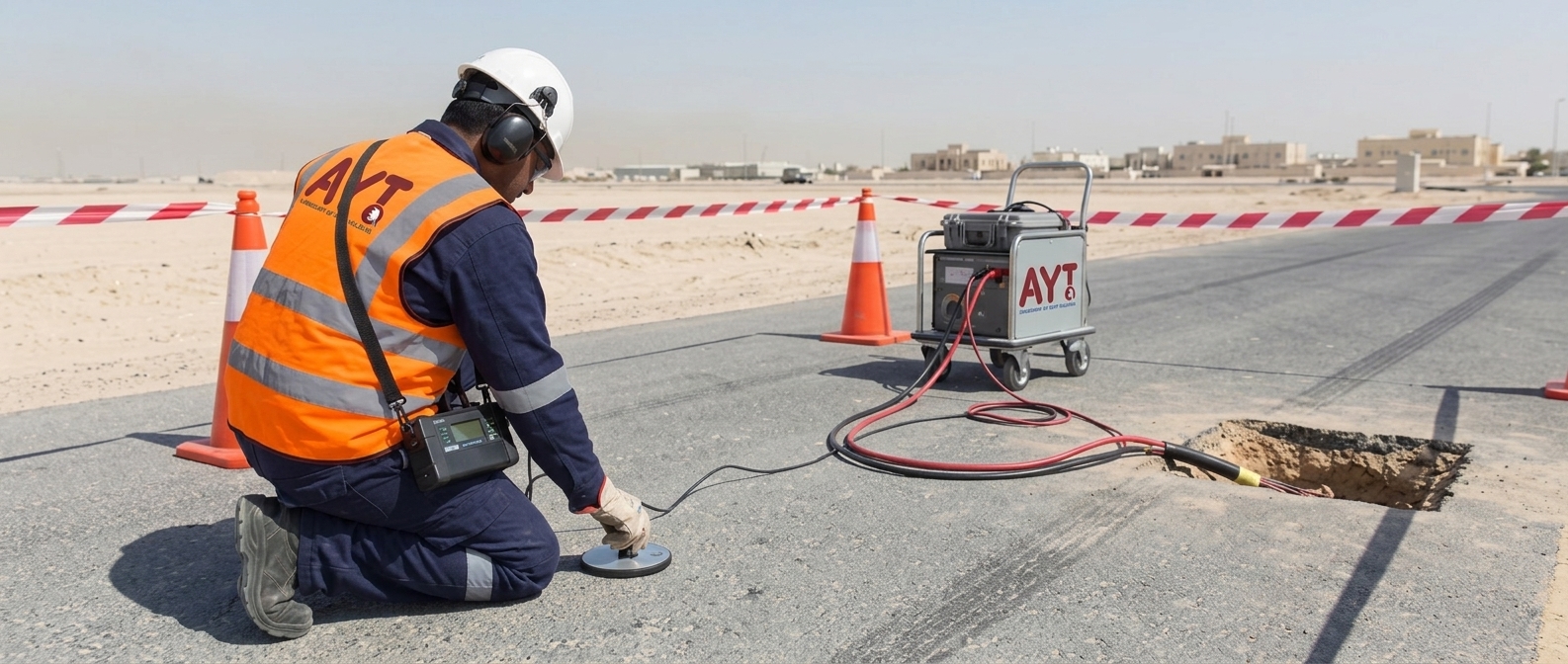
Locating insulation faults and breaks in buried LV, MV and HV cable, accurately enough that you dig one hole instead of trenching the whole route.
How fault location works
A surge wave generator, often called a thumper, launches a high voltage surge onto the faulted cable. The surge travels along the conductor until it reaches a point of dielectric breakdown or a failure in the insulating material, where it discharges across the gap. The fault current returns through the cable neutral or shield, back into the generator, and is dissipated safely to earth.
Where the cable is buried, that discharge produces a small percussion at the fault point, and the resulting soundwave travels up through the ground. The crew works along the route with acoustic detection equipment until the sound pinpoints the position. From there it is a single excavation and a repair, rather than exposing the full run.
Scope
- Fault location on HV, MV and LV cable
- Pre-location by time domain reflectometry to narrow the search area
- Acoustic pinpointing with surge wave generation
- Cable identification and route tracing
- Sheath fault location
- Repair, jointing and retermination once the fault is exposed